
Social Engineering Services
Assumed Breach Vishing
Lares tests how your help desk, service desk, and support workflows respond when a caller already has trusted context, such as an employee ID, case number, or order reference, and uses it to gain access, trigger actions, or extract information.
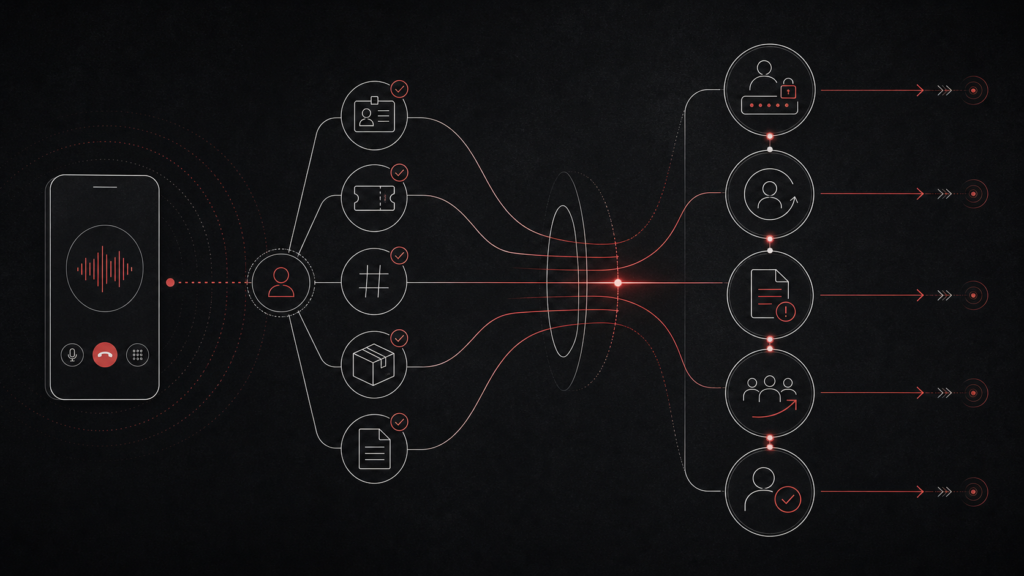
What is Assumed Breach Vishing?
We assume the attacker is already inside. Our operators contact your employees by phone, posing as internal teams or trusted vendors with competing pretexts based on real-world data. The goal is to evalutate how your organization responds when the caller already sounds legitimate.
Who should consider it?
Organizations of all sizes in high-risk environments–especially those handling sensitive data, regulated information, or privileged access–where a single voice interaction can lead to a major breach.
What happens after the caller sounds legitimate?
Trust is established
We build legitimacy with realistic identity, urgency, and context.
Information is requested
Data, access, or actions are requested to "resolve" an issue.
Decisions are made
Your team evaluates the request in real-time.
Risk is realized
We measure outcomes, behaviors, and control effectiveness.
Insights drive defense
You recieve actionable findings to reduce human risk.
Best fit and common use cases
- Privilege abuse and help desk impersonation
- System access and MFA fatigue scenarios
- Data exfiltration and business email compromise
- Incident response and breach verification pretexts
- Executive impersonation and vendor fraud
What Lares tests
- Identity verification & caller trust
- Information disclosure
- Access and system manipulation
- Proccess adherance
- Escalation & help desk interactions
- Awareness under pressure
How the engagement works
We align on objectives and build realistic attacker personas and profiles.
Our operators make controlled calls using realistic pretexts and conversation paths.
We capture responses, outcomes, and control effectiveness across your organization.
We analyze results against industry benchmarks and threat intelligence.
You recieve a detailed report with actionable recommendations to strengthen risk management.
Assumed Breach Vishing vs Traditional Vishing
| Capability | Traditional Vishing | Lares Assumed Breach Vishing |
|---|---|---|
| Attacker Starting Point | Outside the organization | Already inside, or operating with assumed context |
| Caller Identity | Often generic or unknown | Believable, internal, or trusted third party |
| Context & Pretext | Broad or surface-level | Specific, targeted, and data-informed |
| Objective | Awareness testing | Security control and decision testing |
| Complexity | Lower | High realism and adaptive scenarios |
| Insights Delivered | Limited behavior data | Deep behavioral and control-effectiveness insights |
What Clients Get
- Real-world validation of controls
- Actionable risk insights
- Prioritized recommendations
- Executive-ready reporting
- Stronger human defenses
Download the Assumed Breach Vishing Methodology
Frequently Asked Questions
What is assumed breach vishing?
Assumed breach vishing is a voice phishing assessment that tests how your organization responds when an attacker already has a small amount of trusted context, such as an ID, case number, order reference, or other plausible business artifact.
What is the difference between vishing and assumed breach vishing?
Traditional vishing starts from zero and measures how teams handle cold callers. Assumed breach vishing starts with a limited foothold and measures whether trust expands too quickly once the caller appears legitimate.
Is this a red team exercise?
Not necessarily. Assumed Breach Vishing is a focused social engineering service centered on voice-based trust, verification, and escalation. It can stand alone or complement broader red team, insider threat, or social engineering work.
What teams are usually in scope?
Most engagements focus on help desks, service desks, customer support, payroll, HR support, partner-facing teams, or any workflow where phone-based interactions can trigger sensitive actions.
What does Lares measure during the engagement?
Lares measures verification strength, exception handling, escalation behavior, disclosure risk, identity-dependent actions, and how trust accumulates across one or more calls.
Looking for something else?











See how your team responds when the attacker already has access
Let's start a conversation about your human risk.