Physical Security
Secure People.
Protect Assets.
Strengthen Resilience.
Strategic physical security consultancy that reduces risk, hardens operations, and delivers assurance across your environment.
Physical Security
Physical threats are evolving. So should your defenses.
From perimeter breaches to insider risk and infrastructure vulnerabilities, physical threats can disrupt operations, compromise data, and impact safety.
- Unauthorized Access
- Insider Threats
- Perimeter Compromise
- Infrastructure Vulnerabilities
- Environmental Hazards
- Operational Disruption
Our Services
End-to-end physical security consultancy and advisory.
Security Strategy & Governance
Develop practical physical security strategies, standards, and governance models aligned to business risk and operational realities.
Risk Assessment & Threat Analysis
Identify facility, personnel, and operational risks that affect exposure across sites, workflows, and critical assets.
Secure Design & Engineering Review
Review physical security design decisions and supporting controls for effectiveness, resilience, and real-world usability.
Security Systems Advisory
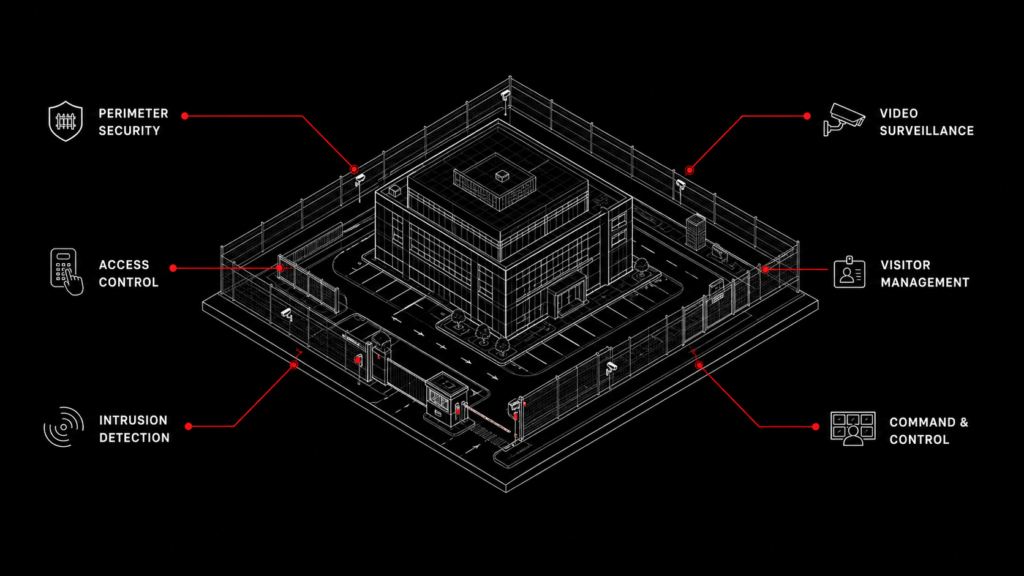
Assess and improve access control, CCTV, intrusion detection, monitoring, and supporting technologies.
Physical Security Program Assurance
Evaluate whether your physical security program is operating as intended across policy, process, staffing, and site execution.
Incident Preparedness & Response Planning
Strengthen response playbooks, escalation paths, and coordination models so teams can act effectively during physical security events.
Our Methodology
A proven, outcome-driven process.
We begin by characterizing the facility, its operating environment, and the assets that matter most. This includes understanding how the site functions day to day, what must be protected, and which undesired events would have the greatest operational impact.
Next, we establish a practical design basis threat that reflects the adversaries, tactics, and conditions most relevant to your environment. This keeps the engagement grounded in realistic attack scenarios instead of generic assumptions.
We review how existing safeguards perform under realistic conditions, including physical barriers, access controls, monitoring, response procedures, and supporting workflows. This helps identify where defenses are effective and where they break down in practice.
We review how existing safeguards perform under realistic conditions, including physical barriers, access controls, monitoring, response procedures, and supporting workflows. This helps identify where defenses are effective and where they break down in practice.
We deliver clear documentation of findings, attack paths, and recommended improvements so your team can strengthen physical security in a practical, prioritized way. The focus is not just on what failed, but on what to change next and how to improve over time.
Outputs & Deliverables
Clear results. Practical next steps.
- Executive summary & briefing
- Physical security strategy & roadmap
- Risk assessment & remediation plan
- Design review findings
- Systems recommendations
- Policy and procedure guidance
- Implementation roadmap
- Maturity assessment
Frequently Asked Questions
What does a physical security assessment test?
A physical security assessment evaluates how well your facility, controls, and procedures prevent, detect, and respond to real-world threats. Depending on scope, that can include perimeter security, access controls, alarms, cameras, visitor handling, and physical attack paths.
How is this different from a secure site review?
A secure site review examines the effectiveness of existing physical controls and protections across the facility. Physical penetration testing goes a step further by validating whether those controls can actually be bypassed in practice.
Can Lares test more than doors and locks?
Yes. Lares’ physical security testing includes techniques such as lock picking, access system bypass, magnetic door brute forcing, camera redirection, alarm avoidance, elevator compromise, ventilation entry, badge compromise, and safe or vault access.
Do you test alarm and surveillance systems too?
Yes. Lares assesses the alarm systems in use and performs real-world testing to identify bypasses, backdoors, weak configurations, and other conditions that reduce effectiveness. The secure-site review process also looks closely at cameras and related protective controls.
Can this include social engineering or converged attacks?
Yes. Lares explicitly includes social engineering, tailing, badge procurement, access card cloning, solicitation, and converged electronic and physical attacks as part of its physical security testing approach. That matters because real attackers often combine methods instead of relying on a single path.
How do you scope the engagement safely?
Lares starts by characterizing the facility, identifying critical assets and undesired events, and defining a design basis threat before testing begins. That keeps the work realistic, controlled, and tied to the risks that matter most to the client.
What do clients receive at the end of the engagement?
Clients receive clear findings and practical recommendations to improve protection, detection, and response across the physical environment. Lares’ broader positioning also emphasizes actionable reporting and guidance that supports real improvement, not just issue identification.
How is this different from red teaming?
A physical security engagement focuses on facilities, physical controls, and attack paths into the environment. Red teaming is broader and tests protection, detection, and response across physical, electronic, social, and converged attack surfaces through active adversary simulation.
Looking for something else?