
Social Engineering Services
Test the human attack surface.
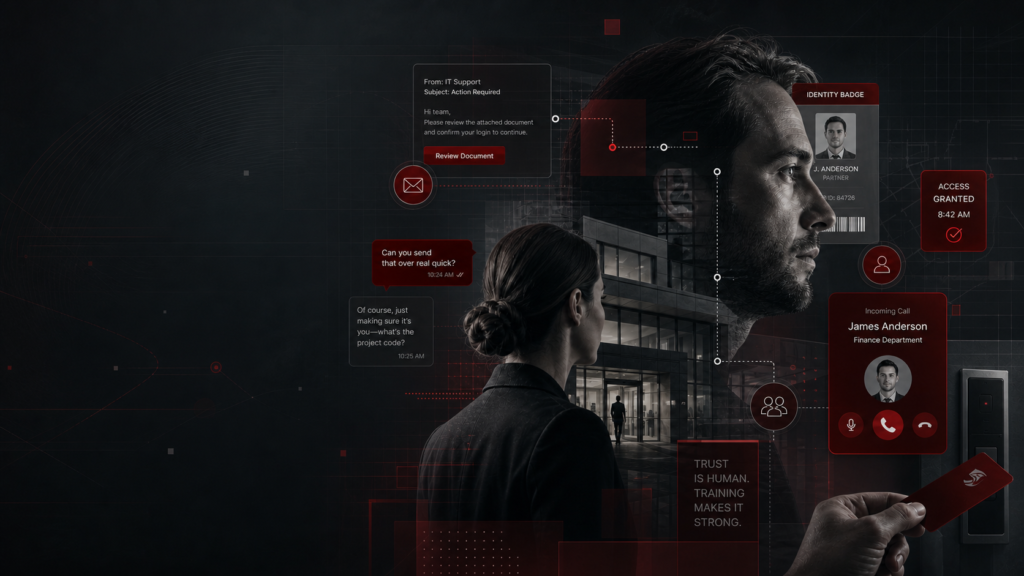
Attackers don't break in - they log in, call in, and walk in. We use realistic social engineering to expose how people, processes, and trust can be exploited - before they are.
Common Social Engineering Risks
Attackers exploit psychology and trust to bypass controls. We help you uncover wehre you're most vulnerable.
Phishing
Deceptive emails lure users to malicious links for attachments that steal credentials or deliver malware.
Example Scenario
HR policy update email leading to a fake login page.
Vishing
Attackers call targets and pretend to be trusted individuals to extact sensitive information.
Example Scenario
IT help desk call requesting MFA push approval.
Impersonation
Adversaries pos as executives, vendors, or partners to gain access or transfer money.
Example Scenario
CEO impersonation requesting urgent wire transfer.
Onsite Intrusion
Attackers leverage pretexting and tailgating to gain physical access to secure facilities.
Example Scenario
Contractor pretext to access restricted office area
Our Social Engineering Services
Social Engineering Assessments
Comprehensive campaigns across phishing, vishing, impersonation, and physical intrusion vectors.
Vishing Campaigns
Realistic voice-based attacks to test information disclosure and authentication workflows.
Impersonation Testing
Executive, vendor, and partner impersonation to evaluate trust and business processes.
Physical Security Tests
Pretexting, tailgating, and badge cloning assessments to test facility and personal security.
Awareness & Coaching
Targeted training and simulations to strengthen human defenses and measure progress.
Deliverables
Scoping & Intelligence
Understand objectives, identify targets, and gather open-source intelligence to inform realistic attacks.
Threat Modeling
Map likely attack paths and select the most effective social engineering pretexts.
Campaign Execution
Launch multi-vector engagements using realistic tradecraft and monitor responses.
Analysis & Validation
Analyze results, validate findings, and correlate impact across people, processes, and tech.
Reporting
Deliver clear, actionable insights with risk ratings and business context.
Remediation Support
Provide guidance and support to close gaps and human defenses.
Our Methodology
Executive Summary
High-level overview of findings, risk posture, and key recommendations.
Attack Narrative
Detailed walkthrough of techniques used, what occured, and business impact.
Findings & Risk Analysis
Comprehensive findings with evidence, impact, and risk prioritization.
Remediation Guidance
Prioritized, practical steps to reduce risk and improve human defenses.
Frequently Asked Questions
What does a social engineering assessment actually test?
A social engineering assessment measures how well your people, processes, and controls stand up to deception-based attack scenarios. Depending on scope, that can include phishing, vishing, smishing, impersonation, tailgating, USB drops, pretexting, and attempts to solicit sensitive information or gain access.
How is this different from standard phishing simulation?
A standard phishing simulation usually measures broad awareness and click behavior. A social engineering engagement goes further by testing targeted scenarios, business process weaknesses, trust relationships, and human decision-making across email, phone, SMS, and physical channels.
Do you test more than email?
Yes. Social engineering should be presented as a multi-channel service, not an email-only exercise. Lares already references spear phishing, whaling, vishing, smishing, and human-focused attack techniques, and Lares’ vishing content makes clear that phone-based attacks remain highly effective and often under-tested.
Can this include physical social engineering?
Yes. This includes techniques such as tailgating, impersonation, posing as an authority or employee, USB drops, and other methods used to validate exposure in both the physical and digital worlds.
How do you keep the engagement realistic but controlled?
The page should make clear that realism does not mean chaos. Lares’ broader adversarial testing language emphasizes scoped objectives, controlled execution, and realistic attack cadence across social, physical, and electronic surfaces, which is the right model to carry into this page.
What do clients receive at the end of the engagement?
Clients should expect clear reporting that shows where trust-based attacks succeeded, which controls failed, and what to fix first. The current Lares page already promises a comprehensive plan to help stop these attacks, and the rebuild should make that more concrete with executive findings, attack narratives, evidence, and prioritized remediation guidance.
Who is this service best suited for?
This service is a strong fit for organizations that want to validate the human attack surface, measure whether awareness efforts are actually working, and identify whether attackers could use trust, urgency, or process gaps to gain access. It also fits teams that need a realistic assessment of human-layer risk without jumping straight into a full red team exercise.
How is this different from red teaming?
Red teaming is broader. Lares describes red teaming as an active attack simulation across social, electronic, physical, and converged attack surfaces, while a social engineering engagement stays focused on how adversaries manipulate people and business processes to gain information, access, or momentum.
Looking for something else?











Strengthen your human defenses.
Find out how your people, processes, and trust hold up against real-world attackers.